Monday - Friday 07:30 - 17:30, Saturday 07:30 - 16:00
Engineered Floor Fitting in Cricklewood, NW2
Back to Portfolio


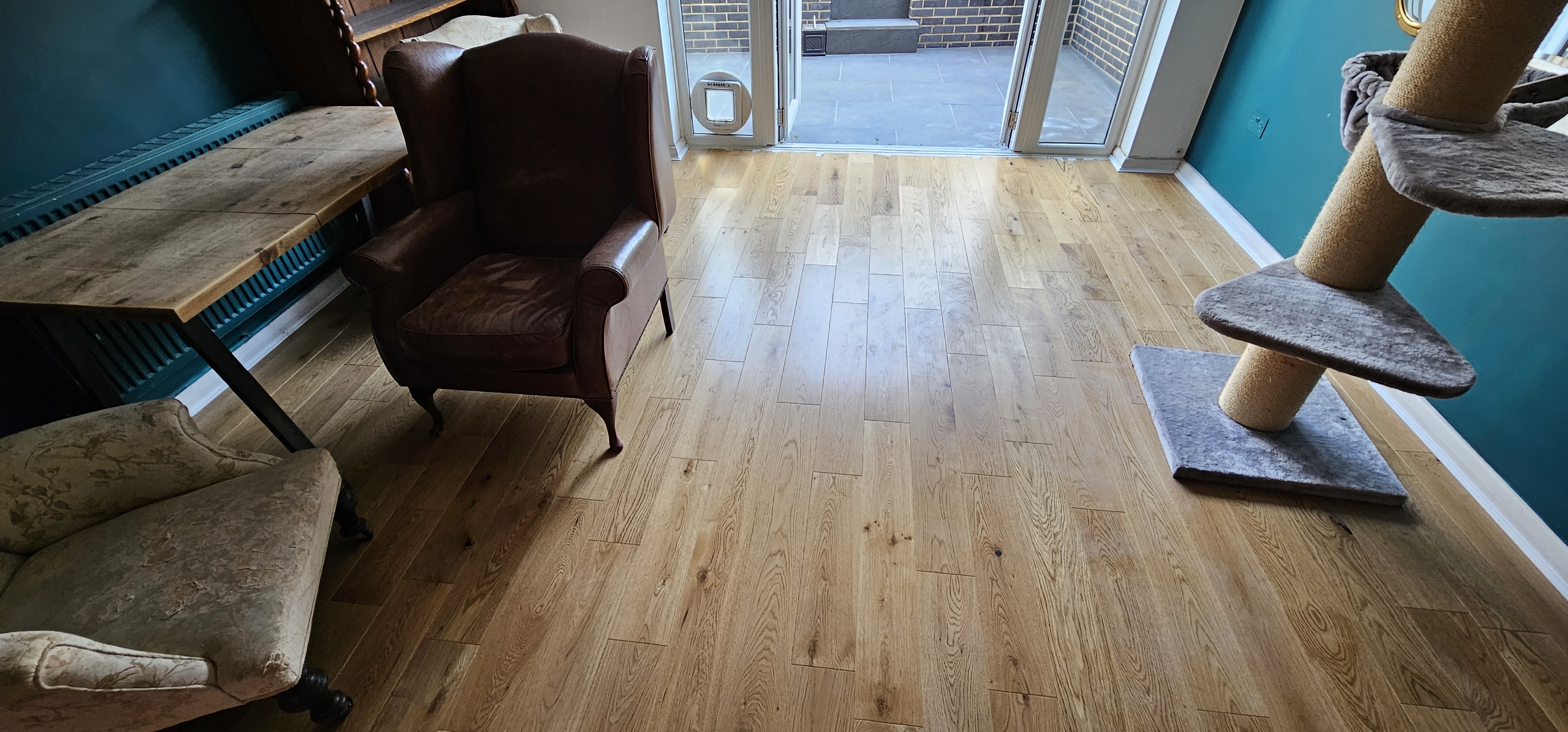
Engineered Floor Fitting in Cricklewood, NW2
We recently completed engineered wood floor fitting in a Victorian terrace in Cricklewood, NW2. The client wanted to replace worn carpet with a durable engineered floor that could handle the movement common in older properties. We fitted approximately 45 square metres across the ground floor, including the hallway, living room, and kitchen area.
Work carried out
- Removal of existing carpet and underlay
- Inspection and preparation of subfloors
- Installation of damp proof membrane in kitchen area
- Fitting of engineered oak flooring using floating method
- Sanding and finishing of exposed edges
- Fitting of threshold strips and skirting boards
- Final inspection and client handover
About the project
This Victorian property presented several challenges typical of older homes in the area. The subfloors were uneven, dropping approximately 20mm across the living room, and there was evidence of historic damp in the kitchen. Rather than pursuing expensive structural repairs, we chose engineered wood specifically for its stability. Engineered boards handle moisture and temperature fluctuations far better than solid wood, making them ideal for period properties where humidity levels can shift significantly between seasons.
Our approach involved taking time to prepare the subfloors properly. We levelled high spots using a floor scraper and filled deeper depressions with levelling compound. In the kitchen, we installed a thin damp proof membrane before laying the engineered boards using a floating system, which allows the floor to expand and contract freely without cracking. The job took five working days from start to finish, with careful attention paid to skirting board removal and replacement to achieve a neat finish throughout.
About our Cricklewood, NW2 service
Cricklewood has a rich mix of property types, and we work regularly across all of them. Victorian and Edwardian terraces dominate the residential streets, many now converted into flats and family homes. We also encounter plenty of converted Edwardian semis, newer purpose built blocks, and increasingly, contemporary new build developments. Each property type presents different flooring challenges and opportunities. Victorian properties often have suspended timber floors that can move, whilst newer builds typically have concrete ground floors that require careful moisture management.
Our experience fitting engineered wood and laminate in Cricklewood means we understand what works in these properties. The local climate, with reasonable moisture levels year round, suits engineered boards well. We're familiar with the common floor layouts in period homes, the typical subfloor conditions we'll encounter, and how to navigate narrow Victorian hallways and period staircases without causing damage. Many of our Cricklewood clients choose engineered wood specifically because it bridges the gap between the appearance of solid wood and the practical durability needed in homes that are often over 100 years old.
Frequently asked questions
How much does engineered wood floor fitting cost in Cricklewood?
Fitting costs typically range from £35 to £60 per square metre depending on the complexity of the room layout, existing subfloor condition, and any preparation work needed. Victorian properties with uneven floors cost more due to extra preparation time. Simpler jobs on modern concrete floors fall toward the lower end of that range. We always provide a specific quote after inspecting the subfloor.
What preparation is required before fitting can begin?
The subfloor needs to be clean, dry, and reasonably level. We'll remove existing flooring, check moisture levels with a meter, and identify any damp or structural issues. In many Cricklewood properties, we need to level out the floor using self levelling compound or floor scraper depending on the extent of unevenness. Preparation can add 1 to 2 days to the overall schedule, which is why it's important not to underestimate older properties.
How long does fitting typically take?
For a straightforward engineered wood fitting on prepared subfloors, we usually work at approximately 10 to 15 square metres per day. A typical Cricklewood terraced house with 40 to 50 square metres of flooring takes 3 to 5 working days. This includes fitting the boards, sanding any exposed edges, installing threshold strips, and replacing skirting boards. Complex layouts with many corners or awkwardly shaped rooms take proportionally longer.
Project Gallery